

Designer Bias in Inclusive Design
Problem
Inclusive design toolkits enable designers to promote greater awareness of biases and provide guidance for designing products that are accessible and usable for a broad range of users. However, designers might not be explicitly aware of their cognitive biases during the inclusive design process.
Our Goal
To enhance the inclusivity of product designs by integrating a tool with the Microsoft Inclusive Design Toolkit, which will help designers explicitly recognize and address cognitive biases that may hinder accessibility and accommodation for a wider audience.
Our Response
'Bias cards' based on common cognitive biases like false consensus bias, confirmation bias, status quo bias and framing bias that can be used before the ‘Ideation’ phase of the Microsoft Inclusive Design Toolkit to make designers aware of possible biases.
Project Details
Working Team:
UX Designers, Engineers, Cognitive Ergonomists (Interdisciplinary Design Team)
Stakeholders / Partners:
Primary Investigators, PhD Students, Faculty Advisors
Context:
University of Michigan, Cognitive Ergonomics / Human Factors–focused academic project
Timeline:
3 months
Scope:
User Research, Cognitive Ergonomic Analysis, Information Architecture, Interaction Design, Accessibility & Usability Evaluation, Prototype Redesign
My Role: User Experience Researcher & Designer, Conflict Resolution Facilitator
Research & Synthesis
Methods: Literature Review on Cognitive Biases, Qualitative Synthesis, Translation of Research into Design Insights
Tools: Academic Databases, Miro, Google Workspace
Team Facilitation & Alignment
Methods: Conflict Resolution, Design Facilitation, Convergence Workshops
Tools: Miro, In-Person Workshops
Design Artifact Development
Methods: Concept Design, Bias Framework Mapping, Card-Based Design Systems
Tools: Sketching, Adobe Creative Suite, Figma
Key Project Highlights
1. Pivots
Pivoted the project scope in response to stakeholder expectations and feasibility constraints, aligning our direction with what was operationally realistic.
2. Tailored questionnaires
Developed tailored bias questionnaires and an analysis rubric aligned with our problem space
3. Challenges with team convergence
Faced challenges in team convergence due to varied interests, making empathy-building essential
4. Collaborative Play
Used collaborative games to resolve team conflict and strengthen shared understanding
5. Research Gap
Identified a research gap around designer bias, especially within product design contexts
6. Design Heuristic Cards
Grounded the creation of bias cards in established frameworks, including Design Heuristic Cards by Shana Dally et al.
Design Process
-
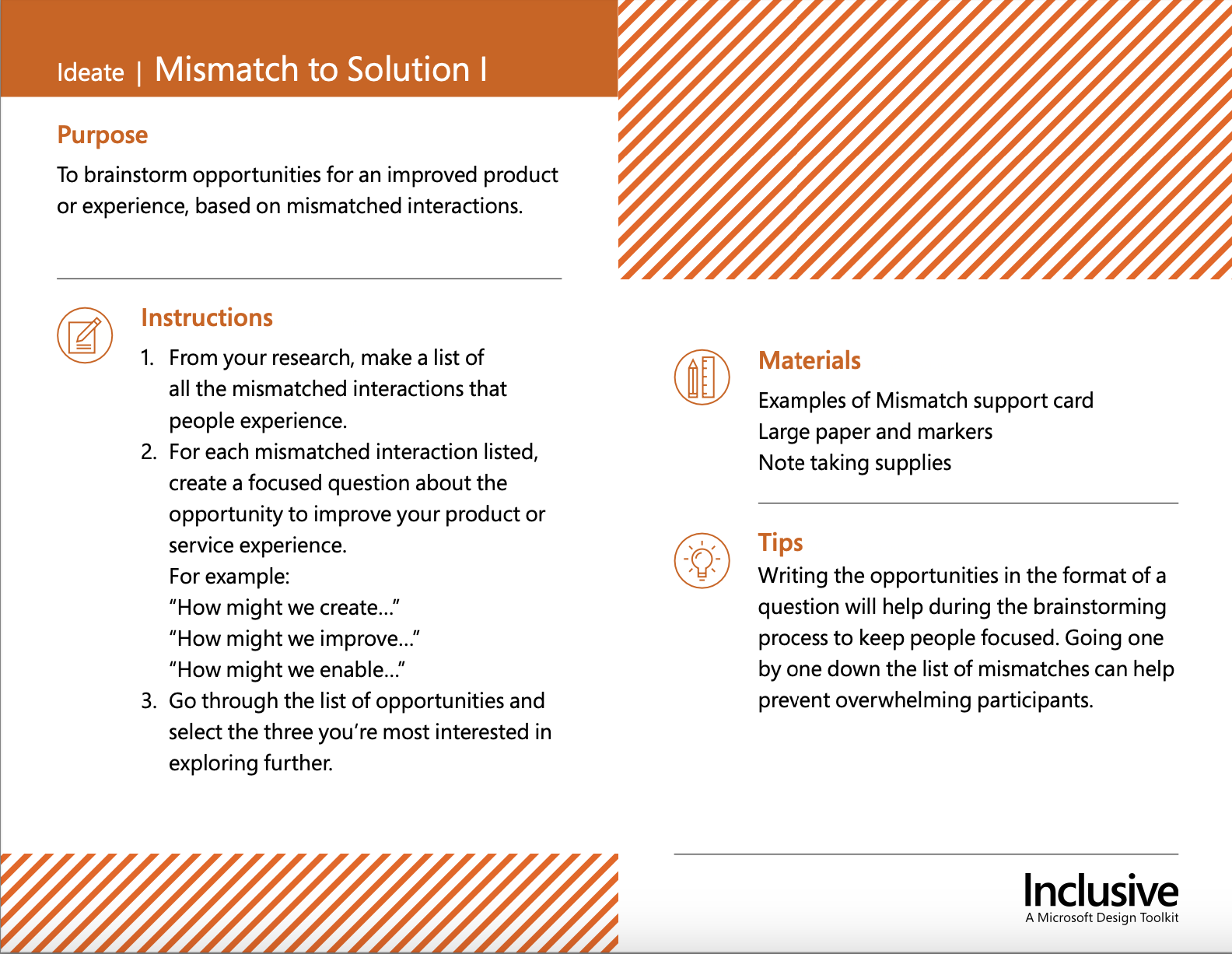
Toolkit Evaluation
Exploratory research of Inclusive design toolkits like Cambridge Inclusive Design Toolkit and Microsoft Inclusive Design Toolkit which enabled us to find gaps and delve into the relationship of inclusive design and cognitive biases.
-

Downselection
We used a qualitative approach to identify common designer biases by conducting a systematic literature review. Search terms "Bias_Name" AND "design*" were used in online databases limited to English-language articles related to product and user-experience design.
-

Survey Analysis
Bias Questionnaire score for objective questions and Thematic Analysis for subjective questions which enabled us to understand user attitudes, user choices and unconscious bias that may occur. It also helped us think about diversity of ideas and bias.
-

Design of Cards
The bias cards were designed based on the Microsoft Inclusive design toolkit theme (Purpose, Materials, Activities) and Design Heuristics cards (pictorial representation of the bias) to better inform users about each bias.
-

Validation of Toolkit
We evaluated and validated the toolkit through expert interviews, user feedback, and survey insights, which guided iterative refinements to improve usability.
-

Evaluation of Results
Comparative Analysis between Group A (Microsoft ‘Ideate’ phase cards) and Group B (Bias cards and Microsoft ‘Ideate’ phase cards. This helped us understand that there are notable differences in each group with regards to number of ideas generated, diversity of the ideas and bias before ideation as well


Solution
Bias cards that will enable designers to explicitly be aware of the common biases that can occur during the ideation design phase.
Key results:
Hypothesis I: Bias cards are effective in reducing personal biases. Group B who received the bias cards had lower bias scores than Group A except for False Consensus Bias.
Hypothesis II: Cognitive biases are present in designers. Evidence of status-quo bias was observed in the comments made by a participant in Group A. Higher bias scores were also observed in Group A.
Hypothesis III: The bias cards help in generating a diverse set of ideas. Group B generated more ideas than Group A, indicating a proxy for diversity. However, the thematic analysis did not provide clear evidence to support this hypothesis.
Key Takeaways
-
Team dynamics
Developing healthy team norms and dynamics, including clear role assignments and prioritizing project timelines, is crucial for the success of any project.
-
End to research
It is important to conduct thorough research to obtain reliable and valid results, but it is also important to know when to stop and conclude the research within a reasonable timeframe.
-
Results can vary
It is important to be open to unexpected results and acknowledge that they can differ from initial assumptions and hypotheses in research.