

Redesign a Mental Health website
Problem
Due to a lack of organization and an excess of information on Therapy Route website, users encountered difficulties in finding available therapists. Furthermore, the search process led to frustration as users struggled to recover from errors.
Our Goal
To redesign the Therapy Route website in order to improve user satisfaction and ease of use, through both evolutionary and revolutionary changes.
Our Response
Redesign website with user mental models, attention span, Artificial Intelligence, Virtual reality and multimodal feedback, including search engine, tutorial, and recommendation system.
Project Details
Working Team:
UX Designers, Engineers, Cognitive Ergonomists (Interdisciplinary Design Team)
Stakeholders / Partners:
Primary Investigators, PhD Students, Faculty Advisors
Context:
University of Michigan, Cognitive Ergonomics / Human Factors–focused academic project
Timeline:
3 months
Scope:
User Research, Cognitive Ergonomic Analysis, Information Architecture, Interaction Design, Accessibility & Usability Evaluation, Prototype Redesign
My Role: User Experience Researcher & Designer
User Research
Methods: Heuristic Evaluation, Semi-Structured Interviews, Behavioral Observation, Cognitive Task Analysis, User Enactment
Tools: Zoom, Miro
Workflow & Task Analysis
Methods: Task Analysis, Cognitive Walkthroughs, Identification of Human and Systemic Errors
Tools: Miro
Interaction & UX Design
Methods: Sketching, Wireframing, Concept Modeling
Tools: Paper Prototypes, Figma
Testing & Synthesis
Methods: Usability Testing, Feedback Synthesis, Thematic Analysis, Affinity Mapping
Tools: Zoom, Miro
VR and Mental Health
A VR video for onboarding and informing users about FAQ’s
Key Project Highlights
VR collaboration
Collaboration with VR students to develop an onboarding VR experience that addresses user confusion about therapy and anxiety related to therapy in a real-life setting.
2. Research
Research on the use of VR in psychology, particularly related to phobias, to inform the development of the VR experience.
3. Innovating thinking
Exploration of innovative ways to keep the audience engaged and manage their expectations despite outdated VR technology.
4. AI chatbot
Integration of an AI chatbot technology to help users find what they are looking for based on their interactions with other websites.
5. Collating past experiences
Discovery research collating experiences of past clients who have used the website to inform design decisions and improve user experience.
6. Clear Onboarding Experience
Redesign with a focus on therapy settings, processes, and inner workings, using FAQs from the VR team's website and user interviews as a starting point.
Design Process
-

Design Heuristics Evaluation
In the Design Heuristics Evaluation stage, we assessed the website design using established principles (such as Wickens', Shneiderman's, and Nielsen's), which ensures user-centeredness and accurate execution of user commands. We identified deviations in designs and classified them into domains like interface, functionality, attention, error and information presentation.
-

Cognitive Task Analysis
We conducted preliminary user research interviews aiming at learning about user’s understanding of what tasks they would look for based on their previous experience with other websites. We conduct detailed user interviews with three participants to gain insights and understanding of the process induced by the current website design.
-

Personas
We created 3 personas between the ages 25-36, with different user pain points, user needs like advanced time management techniques without complex website designs, responsive service that offers therapy and therapist details, informative and intuitive user interface for a therapist-client matching service mobile platform.
-

Scenarios
We created two scenarios; searching for therapist and contacting the therapist, to determine user actions, pain points, user needs, user motivations, and to identify opportunities for improving the website design.
-

Prototype
We designed a mid-fidelity prototype based on user research and conducted usability testing to help iterate further.
-

Think-out Loud Feedback
We requested users to interact with the website and perform think-aloud protocols before and after the interviews to record their observations.
Solution
Our solution enhances the user experience by providing a redesigned search engine with improved location and search criteria control, a user-friendly tutorial, and multimodal accessibility. We've also introduced an AI chatbot, a therapist recommendation system, and a virtual reality solution to help users find the right therapist and better understand therapy settings.

Key system features:
Tutorial for new visitors
Redesign search engine
Multimodal Accessibility
AI chatbot
Recommendation system
Virtual Reality
Gamification of training to provide a multi-modal delivery of feedback and visual guidance.
Product Features
-
Tutorial for new visitors
We added a tutorial to the website to enhance the user experience for new visitors, providing guidance on the website's affordances, tasks and facilitating navigation to find the required information.
-
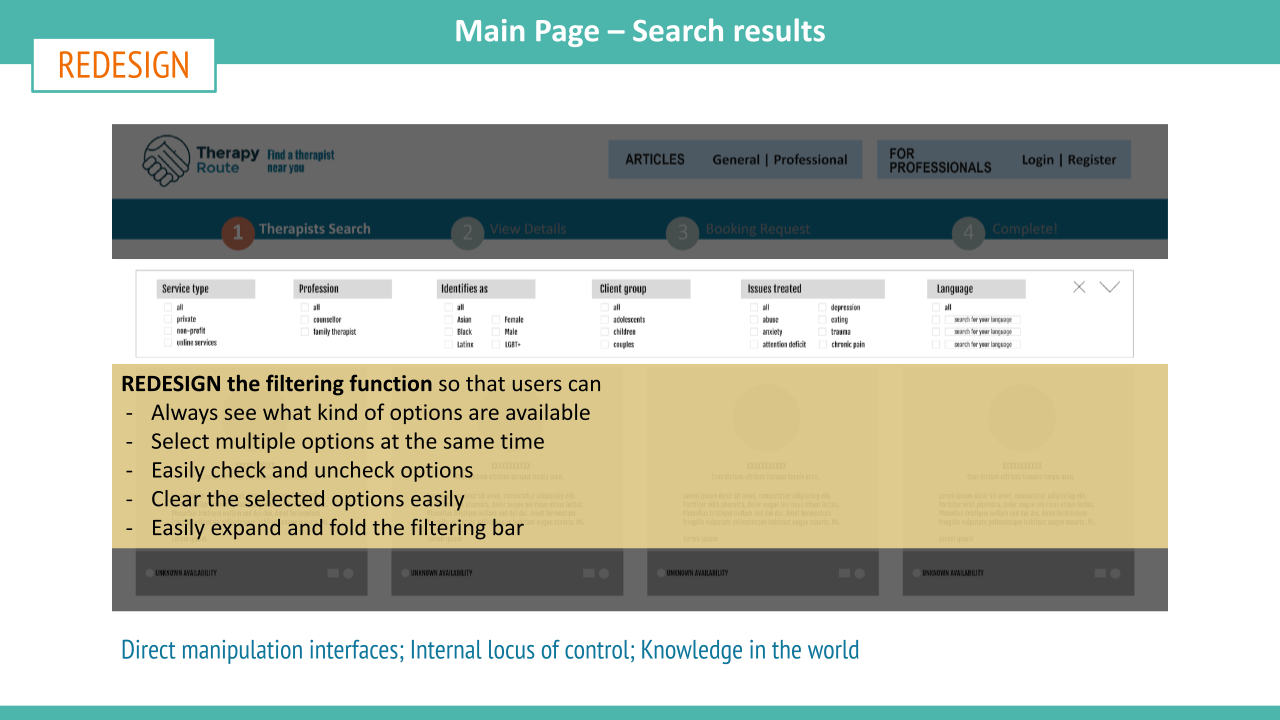
Redesign search engine
The redesigned search engine on our website offers users more control over location information and the ability to search using different criteria, making it easier for them to find therapists that meet their needs and preferences.
-

Multimodal Accessibility
Providing both visual and audio options for information gathering can enhance accessibility for a diverse range of users by allowing them to choose the method that best suits their needs and preferences, ultimately improving the overall user experience.
-

AI Chatbot
Our AI chatbot is equipped with an algorithm that generates a range of options for users to select from based on available data and previous responses. In case the options do not fully address the user's needs, they can also type their own response, enabling the chatbot to effectively cater to the diverse needs of its users.
-

Recommendation system
Utilizing a list of questions to gather user preferences can assist in finding the therapist that best fits their needs by filtering available therapists, allowing users to narrow down their search and find a suitable match with ease.
-
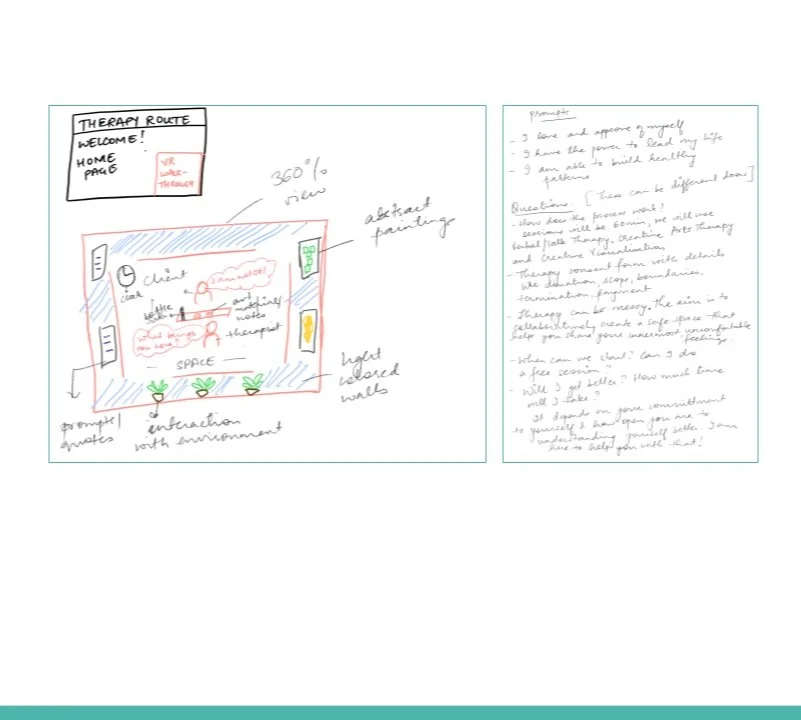
Virtual Reality Onboarding
Our VR solution provides information to users on frequently asked questions or common concerns such as the concept of therapy, therapy spaces, and the therapy process. By offering this information beforehand, our design aims to create transparency, clarity, and trust, ultimately setting realistic expectations for users.
Comparative Evaluation
Quantitative User Study Plan
A lab experiment with 40 participants who are interested in mental health care services but do not have prior experience with this website, comparing the evolutionary redesigned website with the original one to see if changes result in a better user experience. The plan consists of within-subjects and between-subjects design, measuring task performance time and eye gaze analysis through NASA-TLX questionnaire for workload, SUS questionnaire for usability and 7-point Likert scale for satisfaction, through the statistical method of two-way ANOVA.

Qualitative User Study Plan

A focus-group interview with 6 participants, out of which 3 will be novices and 3 of those who have used similar services in the past, comparing the evolutionary redesigned website with the original one to see if changes result in a better user experience. The plan is to make the participants interact extensively with both, original design and redesign of the website prior to the focus-group interviews. Once they have interacted with the website, users will be asked questions and encouraged to actively share their thoughts and a thematic analysis will be performed for qualitative analysis of data.
Key Takeaways
-
Communication
To be able to translate user research findings in a tangible, technical aspect to advance the human-machine interaction.
-
Prescriptive Design
Determining risks early and anticipating user actions based on user mental models can enable the designers to prescriptively design towards reducing errors and cognitive load.
-
User Processing models
Processing models such as top-down processing and bottom-up processing were crucial in empathetically understanding user behavior with interfaces and systems and design toward maximizing user satisfaction