

Un-Block: Your keychain to Stress Management
Problem
Female D-1 student athletes at the University of Michigan face high stress levels on and off campus, highlighting the need for a portable stress management solution.
Our Goal
Our goal is to enhance the overall well-being of female student-athletes by designing cost-effective, easily accessible, and eco-friendly stress management solutions.
Our Response
A keychain designed to help users manage stress through a combination of tactile sensation and the 5-4-3-2-1 grounding technique.
Project Details
Working Team:
UX Designers, Engineers, Materials Designer, Community Specialist, Student Athlete Collaborators (Interdisciplinary Design Team)
Stakeholders / Partners:
Division I Student Athletes, Faculty Advisors, Product Development Mentors
Context:
University of Michigan — Applied Product & Analytical Design Academic Project
Timeline:
3 months (semester-long project)
Scope:
User Research, Product Strategy, Market Analysis, Low- to High-Fidelity Prototyping, Concept Validation, Alpha Testing, User Feedback Synthesis, Iterative Refinement
My Role: User Experience Researcher
User Research
Methods: Literature Review, Market Analysis, Contextual Inquiry, Semi-Structured Interviews, Surveys
Tools: Zoom, Miro, Google Workspace
Experiential & Behavioral Analysis
Methods: Experiential User Enactment, Behavioral Observation, Integration of Movement Therapy & Psychology Principles
Tools: In-Person Enactments, Miro
Concept Development
Methods: Concept Ideation, Concept Modeling, Stakeholder- and User-Grounded Concept Generation
Tools: Sketching, Miro
Testing & Synthesis
Methods: Alpha Testing Support, Feedback Synthesis, Thematic Analysis, Affinity Mapping
Tools: Physical Prototypes, Miro
Key Project Highlights
Discrete Product
Users required an easily transportable, aesthetically pleasing and discrete product that could enable them to use it without catching any attention.
2. Dissatisfaction with products
Users reported high levels of stress and were not satisfied with stress management products in the market.
3. Stigma
User interviews stated that users were scared of being judged and seek therapy.
4. User Mental Models
User mental models were considered during product development, drawing inspiration from a personal story of an athlete experiencing stress.
5. Design for Variability
During the ideation phase, we designed for variability, as well as considered anthropometry aiming towards user satisfaction.
6. Experimentation
Testing and feedback was conducted through experiential facilitation and user enactment.
Design Process
-

User Interviews
Through user interviews, we gained a deeper understanding of the context in which our product is used, as well as user actions, pain points, and suggestions for improving the system.
-

Market Research and Analysis
We conducted a literature review and survey to analyze attitudes towards different product attributes and assess the demand for Un-Block, in order to understand the competitive landscape and identify potential gaps in the stress management product market.
-

Concept Mapping
As a team, we generated concepts and ideas based on concept tree, worst ideas ever, heuristic cards, functional decomposition, combinational table. We then decided on our top concept through down selection process based on affinity maps and feasibility map.
-

Decision Matrix
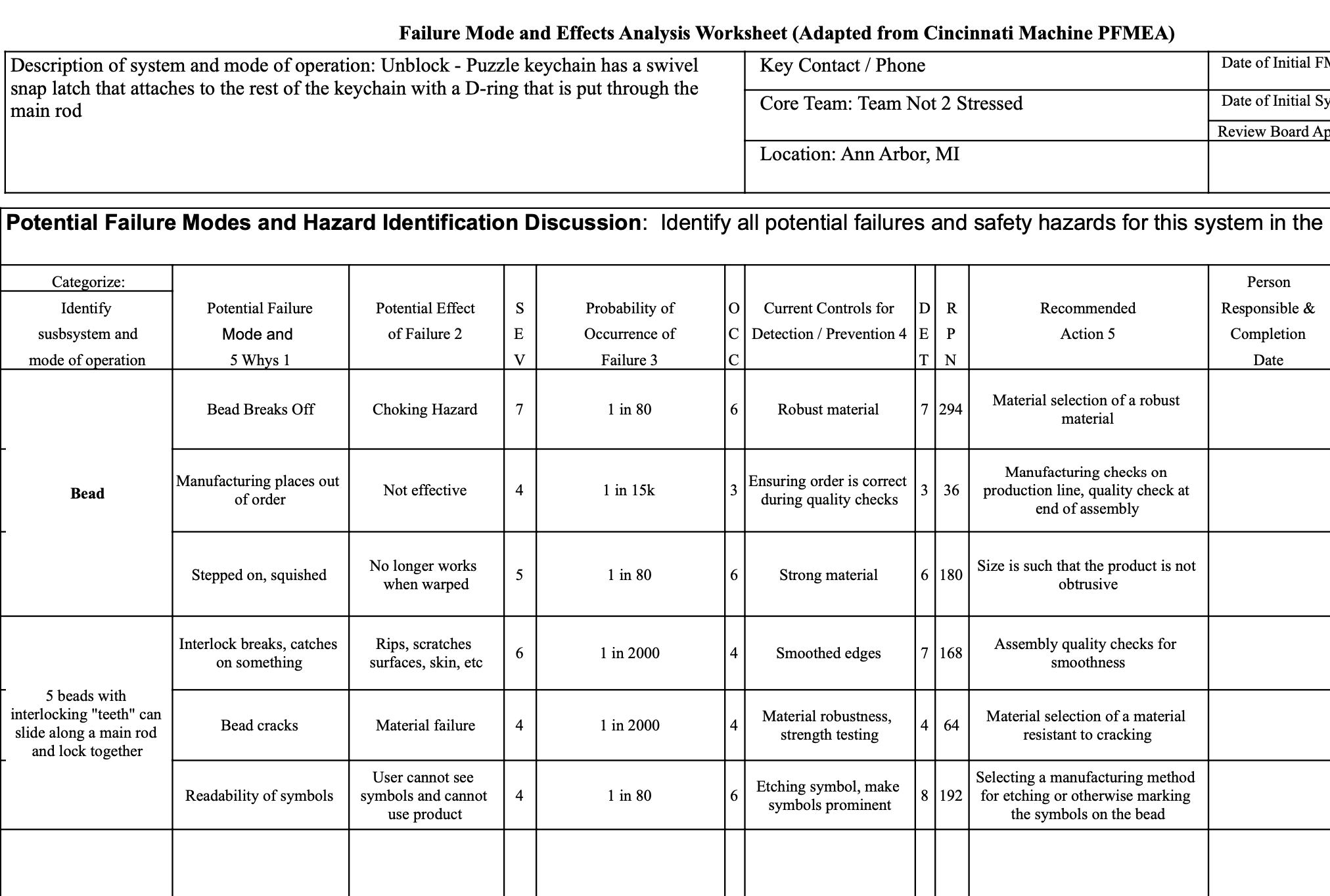
Out of 288 ideas, we decided to converge on 6 top ideas based on user pain points, user needs by each team member generating one idea. We then used the Pugh Chart to decide on our top idea. We also conducted FMEA that helped us converge ideas based on user safety and risk analysis.
-
Failure Analysis
Failure analysis was embedded throughout our design process. Early in the project, the team conducted a preemptive failure analysis to identify potential points of failure, misuse scenarios, and safety hazards. This proactive approach allowed us to anticipate where the product might break, cause discomfort, or introduce unintended risks.
-
Functional Decomposition
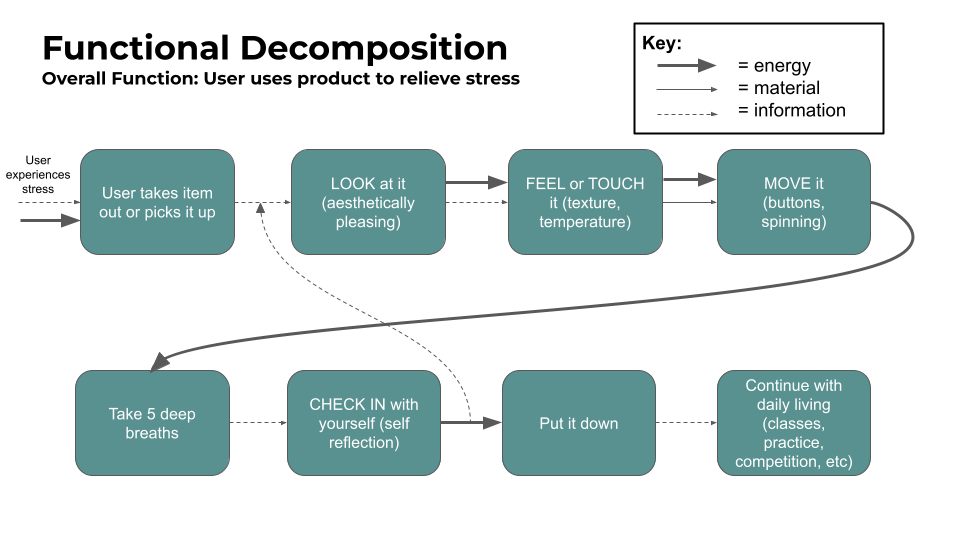
we used functional decomposition to break the product into its essential functions and sub-functions. By clearly outlining what the keychain needed to do provide tactile engagement, enable smooth motion, and remain durable and secure, we could evaluate how each component contributed to these goals. This clarity helped us target improvements, refine mechanisms, and ensure every design choice served a purposeful function in the final product.
-
Morphological Chart
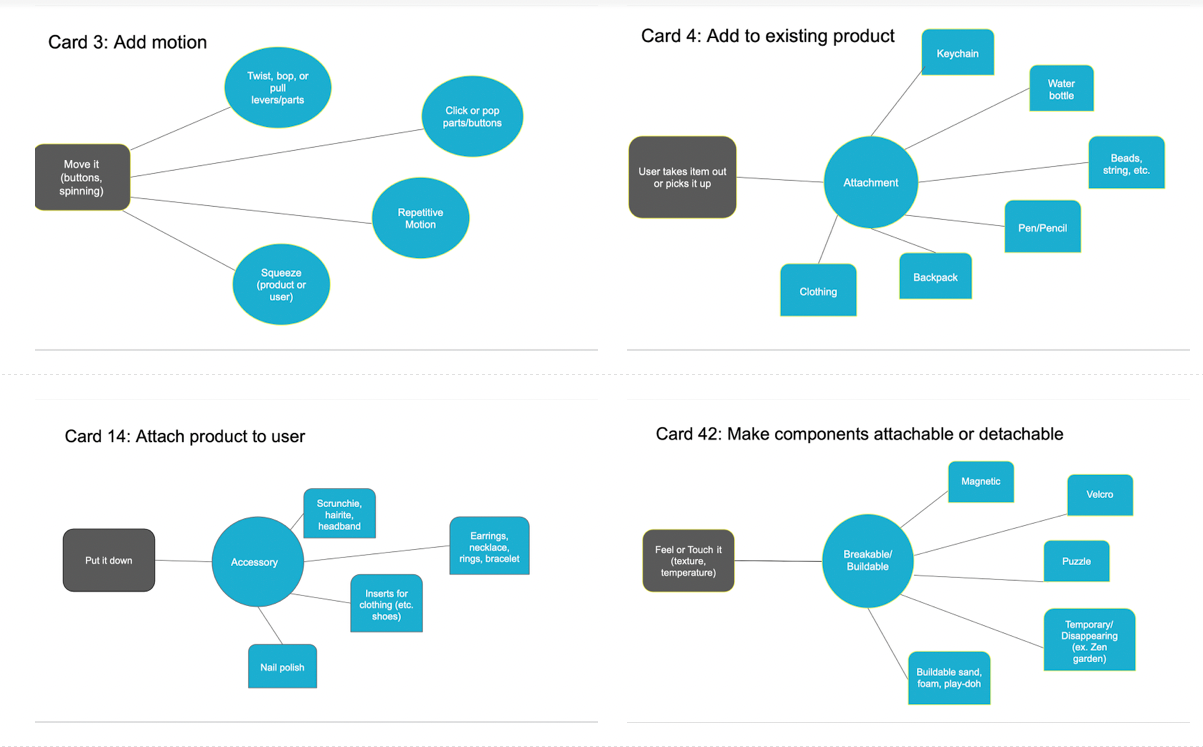
We used a morphological chart to explore a wide range of functional possibilities for our product. By identifying key functions and generating multiple ways to achieve each, we were able to rapidly ideate diverse design concepts and select the combinations that best aligned with user needs and product feasibility.
-

Prototyping and Testing
We created low- and mid-fidelity prototypes and tested them with users to explore how they engaged with the grounding technique and the keychain’s sensory affordances. Through alpha and beta testing, we gathered insights on user associations with the five senses and incorporated stakeholder requirements, allowing us to refine the product concept and interaction experience.
Solution
A keychain that focuses on stress management through the interaction of the human senses with the environment.
Key system features:
By focusing on their 5 senses and breathing, Un-Block enables users to orient themselves in the present moment and cope with stress in any situation.
The Un-Block keychain makes stress management accessible and convenient for busy individuals, like student-athletes, by incorporating the grounding technique into their daily routines.
Magnets are used to stick the rings together to help users experience satisfaction of completing the technique.
The keychain requires the user to create an upward motion to physically engage with the product.
The product has the capacity to be scaled to all audiences.
Key Takeaways
-
Conflict resolution
A diverse and collaborative team of six designers with a shared passion for positive societal impact managed to navigate the storming phase by empathetically considering each other's opinions and voting for the best ideas.
-
Convergent and Divergent Thinking
Convergent and Divergent thinking is important in oder to generate multiple creative ideas and converge them into possible solutions that cater to user and stakeholder needs.
-
Lean UX and Agile Design
Lean UX and Agile process are equally important and can be used collaboratively depending on the problem statement, time constraints, availability of users, and user and stakeholder goals.